







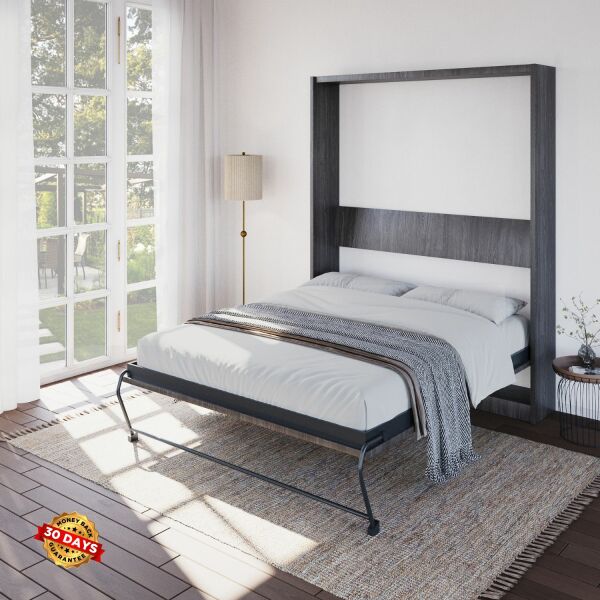
Murphy Beds vs Wall Beds vs Hide-a-Beds — What's the Difference?
If you've started searching for a fold-down bed solution for a spare room, apartment or home office, you've probably encountered three terms used almost interchangeably: murphy bed, wall bed, and hide-a-bed. They all refer to the same basic concept — a bed that folds away when not in use — but the terms have slightly different origins and sometimes refer to different designs. Here's what each one means and how to decide which is right for your space.
What is a murphy bed?
The name comes from William Lawrence Murphy, who patented a fold-down bed design in the early 1900s. A murphy bed folds vertically into a cabinet or wall unit — you pull it down to sleep on it and push it back up flush with the cabinet when you're done. The mechanism uses either a piston system or a spring-counterbalance to make it easy to raise and lower.
Murphy beds are the most common type of fold-down bed and what most people picture when they hear "wall bed." They're available as freestanding cabinet units, which can be positioned against any wall, or as built-in wall systems.
What is a wall bed?
Wall bed is the broader term that encompasses any bed that mounts to or stores within a wall structure. All murphy beds are wall beds, but not all wall beds are murphy beds. The distinction is mostly technical — in everyday conversation, the terms are used interchangeably, and searching for either one will return the same products.
What is a hide-a-bed?
In North America, "hide-a-bed" often refers to a sofa bed — a couch with a fold-out mattress concealed inside the cushions. In New Zealand, the term is used more broadly and often applied to vertical fold-down beds as well. Mazon's original hideabed is a timber cabinet unit available online.
The term "hideaway bed" refers to similar fold-down designs intended for rooms where space is at a premium — spare bedrooms, home offices, studios and sleepouts.
Which is right for your space?
The design you choose matters less than the dimensions and mechanism. Here's what to check before buying:
- Ceiling height. Most vertical fold-down beds require a minimum ceiling height of approximately 2.2m — 2.4m is more comfortable. Measure your room before ordering.
- Floor space when open. A queen murphy bed, when folded down, occupies roughly the same floor area as a standard queen bed. Make sure there's enough clear space in front of the wall for the bed to fold down fully without obstruction.
- The room's primary use. If the room is a full-time home office, a murphy bed that folds away completely is likely the right choice — the room is usable all day and converts to a bedroom at night. If it's primarily a spare bedroom used occasionally, a standard bed or ensemble may be simpler.
- Online vs in-store. Mazon's murphy bed range includes online options that ship within 1–2 business days — useful if you need a solution quickly or if visiting a showroom isn't convenient.
Will my existing mattress work?
Mazon's Hide-A-Beds take any mattress up to 300mm deep, and the spring mechanism can be adjusted to suit the weight of the mattress you choose. A mattress thicker than 300mm can stop the cabinet from closing properly, so check the depth before you buy. Mazon recommends pairing your Hide-A-Bed with a mattress from the Eco-Coil range.
Can I fit it myself?
Mazon's freestanding cabinet-style hideabeds are designed for self-assembly. Wall-mounted systems are more involved and generally benefit from a professional installation, particularly if you're anchoring into a timber frame rather than a concrete or brick wall. Our team can advise on installation requirements at the time of purchase.
If space efficiency is the goal, a space-saving bed from the Mazon range is one of the most practical investments you can make in a NZ home — particularly in apartments, newer builds with smaller room footprints, or any room that needs to serve more than one purpose.
For bedrooms where comfort positioning and support are the priority, Mazon also offers adjustable bases designed to help customise your sleep setup.